
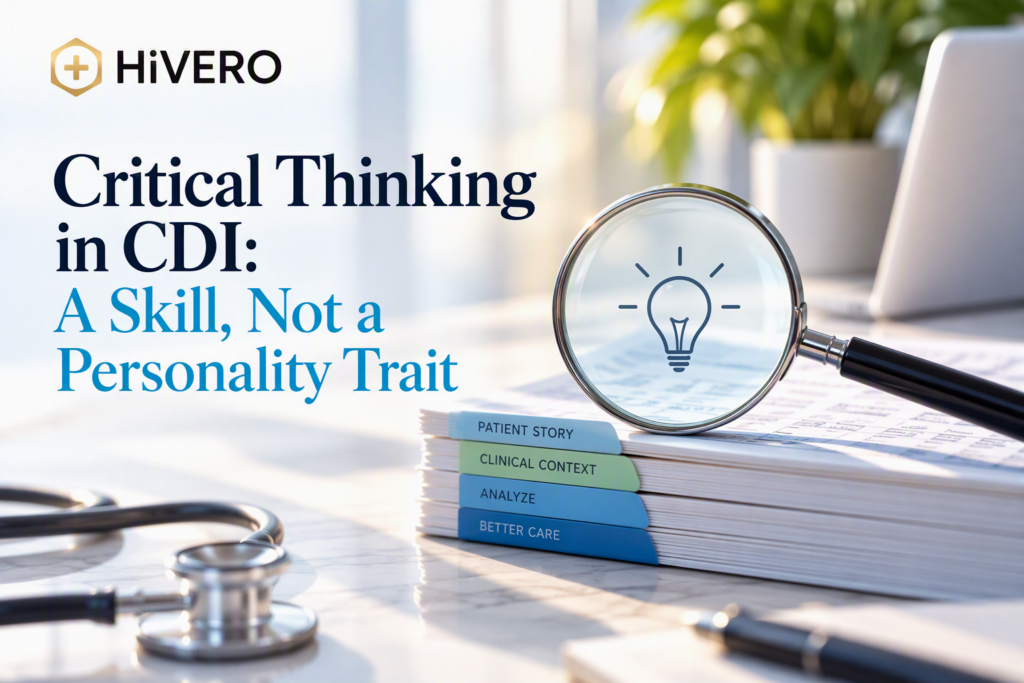
Spend enough time in CDI and eventually you’ll hear someone described as a “great critical thinker.” We say it as though critical thinking is something a person naturally has. Some people are analytical. Some people are curious. Some people just seem to have that ability to look at a complicated chart and immediately see what everyone else missed. But I don’t think critical thinking works that way.
Critical thinking isn’t something you are. It’s something you learn to do. And, more importantly, I believe it’s something we can teach.
That distinction matters in CDI because our work has changed. It’s no longer enough to recognize that a diagnosis impacts the DRG, identify a missing CC or MCC, or spot an opportunity for greater specificity. Today’s CDI professional must look beyond the words documented in the record and ask a bigger question: Does the entire clinical story make sense?
When we’re new to CDI, we often approach a chart by looking for opportunities. Can this diagnosis be further specified? Is there a relationship we need to establish? Is something missing? Is there an opportunity for a query? Those are all important questions, but as we grow in our practice, I think our questions need to grow with us.
Instead of simply asking, “Can I query this?” we start asking, “Does the clinical picture support this diagnosis?” We wonder whether there could be another explanation for the findings. We notice when the treatment plan doesn’t align with what’s documented. We recognize conflicting information and, perhaps most importantly, we learn to pause when we don’t have enough information to reach a conclusion.
That pause is often where critical thinking begins.
One of my favorite ways to describe CDI professionals is as clinical detectives. A good detective doesn’t find one clue and immediately decide the case is solved. Neither should we. We look at physician documentation, nursing assessments, vital signs, laboratory results, imaging, medications, treatments, response to treatment, and the progression of the patient’s condition. Then we start connecting the dots.
Think about something CDI professionals encounter every day: a diagnosis of sepsis. It’s easy to see “sepsis” documented and keep moving through the record. Critical thinking tells us to slow down. What was the suspected source? What were the patient’s clinical indicators? What organ failure is evident and documented? Were abnormal findings present, and could they have another explanation? What treatment was provided? How did the patient respond? Does the overall clinical course tell the same story as the documented diagnosis?
The goal isn’t to prove or disprove what the physician documented. The goal is to make sure the documentation clearly and accurately reflects what is happening with the patient. That becomes especially important when we think about clinical validation, quality reporting, and denials.
I’ve come to believe that one of the most powerful questions we can teach a CDI professional to ask is incredibly simple: Why?
Why is the creatinine elevated? Why does this patient suddenly require oxygen? Why is encephalopathy documented? Why did the hemoglobin drop? Why doesn’t the treatment seem to match the diagnosis? And then comes an equally important question: What else could explain what I’m seeing?
Those questions take us beyond checklist CDI and into clinical reasoning.
A heart rate, white blood cell count, creatinine level, oxygen saturation, or altered mental status does not tell a patient’s entire story. Clinical findings have to be evaluated in context. We must look across the record at subjective and objective assessments, response to treatment, labs, imaging, diagnostic testing, medications, interventions, and provider documentation rather than relying on isolated pieces of information.
Of course, experience helps. Someone who has reviewed thousands of records will probably recognize certain patterns faster than someone who is three months into CDI. But recognizing a pattern and critically evaluating it are not necessarily the same thing.
And that’s why I think we need to be careful about telling someone they simply “need better critical-thinking skills.” If critical thinking is truly a skill, then we have to give people opportunities to develop it.
Give CDI professionals clinical scenarios where the answer isn’t immediately obvious. Ask what they notice before telling them what they should notice. Ask them to explain why they reached a particular conclusion. Change one clinical indicator and ask whether it changes their thinking. Have two CDI professionals walk through the same record and explain their reasoning. Most importantly, create an environment where questions are seen as curiosity and growth, not a lack of knowledge.
That’s how critical thinking develops.
I also think this changes how we define success in CDI. The value of a CDI professional shouldn’t simply be measured by the number of queries identified. Sometimes excellent critical thinking leads to a query. Sometimes it leads to the realization that a query isn’t appropriate. Sometimes it identifies a clinical validation vulnerability before the claim leaves the organization. And sometimes it uncovers a pattern that would be better addressed through provider education or a broader process change.
Ultimately, we have to move the conversation from “How many queries did we find?” to “How well did we understand the clinical story?”
After years of working in CDI and education, I’ve come to believe some of the strongest CDI professionals aren’t necessarily the people who always know the answer. They’re the people who stay curious long enough to ask another question.
Why? What am I missing? Does this make sense? What else could explain this? Do I have enough information to reach this conclusion?
Those questions are the difference between simply reading a chart and truly analyzing one. As CDI continues to expand its influence across clinical validation, coding accuracy, quality, denials, and health record integrity, I believe that ability is more important than ever.
Critical thinking is not a personality trait reserved for a few naturally analytical people. It’s a skill. We can teach it. We can practice it. And we can get better at it. Maybe the goal isn’t to develop CDI professionals who always have the answer. Maybe the goal is to develop CDI professionals who know how to ask better questions.