

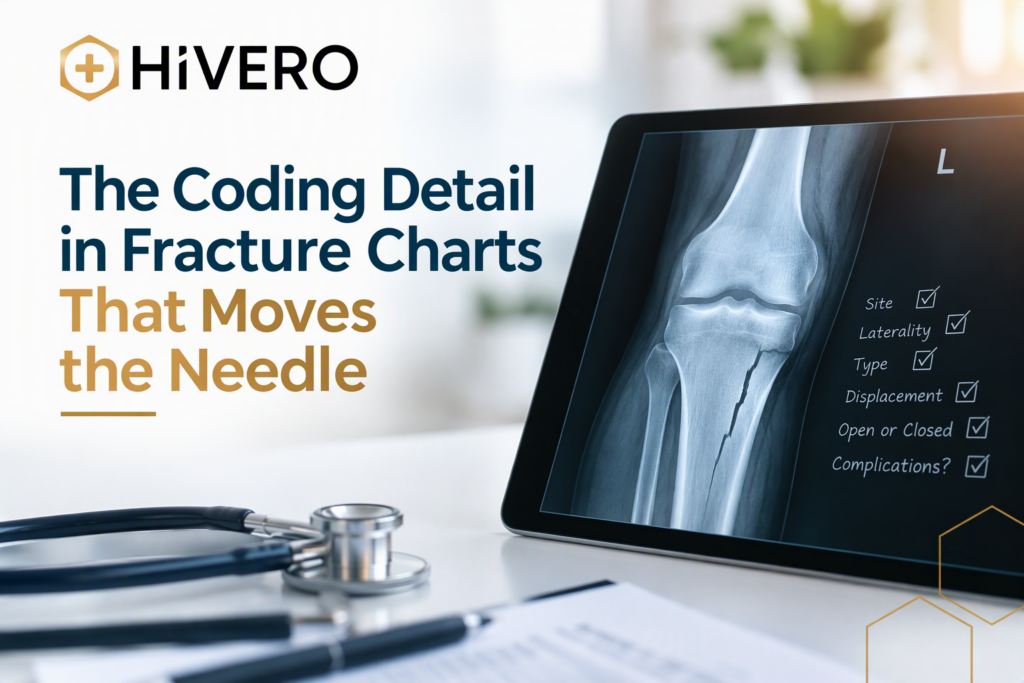
Fracture charts can fool you. At first glance, they seem pretty straightforward. The patient falls, imaging confirms the fracture, orthopedics evaluates, treatment begins, and you move on. Not so fast, though. ICD-10-CM has questions.
Where exactly is the fracture? Right or left? Displaced or nondisplaced? Open or closed? What type? If it’s open, what’s the Gustilo classification? Are we treating the fracture, or are we now in the healing phase? Suddenly, “left femur fracture” isn’t quite enough. That’s where CDI comes in.
Fracture coding is one of those areas where a tiny documentation detail can make a surprisingly big difference. The exact location, laterality, displacement, fracture pattern, open-versus-closed status, Gustilo classification, treatment phase, and healing status can all matter. That’s a lot of responsibility for one broken bone.
And then there’s the seventh character. Remember, “initial encounter” doesn’t necessarily mean the patient’s first visit. For traumatic fractures, it generally reflects the period of active treatment. Once the patient moves into the healing phase, CDI should be paying attention to whether the fracture is healing routinely or whether there is delayed healing, nonunion, or malunion. That seventh character may be small, but it definitely earns its keep.
Open fractures deserve an especially close look. If the fracture is documented as open, is the Gustilo classification there? Sometimes it’s sitting nicely in the orthopedic note. Other times, it’s buried in an operative report or wound description three screens away. Because apparently, documentation occasionally enjoys a good game of hide-and-seek.
Displacement is another easy opportunity to miss. Radiology may give us a beautifully detailed description, while the provider documents simply “right tibial fracture.” Technically true, but we may need a little more information. This is where CDI critical thinking matters. Look at the imaging, orthopedic assessment, and operative report, then compare that clinical picture with the provider’s diagnosis. We don’t need to turn every fracture into a query marathon, but when important, clinically supported specificity is missing, it deserves a second look.
And don’t forget to ask why the bone broke in the first place. A fracture after relatively minor trauma in a patient with osteoporosis, metastatic cancer, or another underlying bone disorder should make us pause. Could the clinical picture support a pathological fracture rather than a purely traumatic one? CDI doesn’t make the diagnosis, but we should recognize when the story raises a question that the documentation hasn’t answered.
Most importantly, don’t stop at the fracture. Fractures don’t always travel alone. Acute blood loss anemia, compartment syndrome, nerve or vascular injuries, infection, wound complications, fat embolism, DVT, PE, and complications of healing may all become part of the patient’s story.
Look for the clues. Did the hemoglobin drop significantly following the injury or surgery? Is the EBL documented somewhere in the operative note? Is there worsening pain, swelling, paresthesia, or a change in neurovascular status? Is anticoagulation being used for routine prophylaxis or to treat a newly diagnosed DVT or PE? Is there wound drainage or concern for infection?
Of course, clinical indicators are not diagnoses. A falling hemoglobin doesn’t automatically equal acute blood loss anemia. A swollen leg doesn’t automatically equal DVT. And severe pain doesn’t automatically mean compartment syndrome. If healthcare were that predictable, our jobs would be considerably easier.
The CDI opportunity is recognizing when the pieces of the clinical story aren’t quite connecting and determining whether clarification is appropriate. Ultimately, good fracture review isn’t about squeezing one more word into the diagnosis for the sake of specificity. It’s about making sure the coded record reflects what actually happened to the patient.
So, the next time you see “fracture” in the chart, don’t scroll past quite so quickly. Where is it? Which side? What type? Displaced or nondisplaced? Open or closed? How is it being treated? How is it healing? Why did it happen? And what else happened because of it?
Because sometimes the biggest CDI opportunity isn’t the fracture itself. It’s the complication hiding three progress notes later, hoping you’ve already moved on.