
If you’ve worked in CDI for any length of time, you know the feeling. You’ve done the education. You explained the rationale, sent a clear query, followed up, and somehow, you’re back looking at the same documentation gap three weeks later. It’s frustrating. Especially when the education itself was solid. At some point, you start asking what’s actually not connecting here?
Here’s what I’ve come to believe in. The problem usually isn’t the content. Providers can receive perfectly accurate, well-organized information and still not change anything, because the message didn’t feel relevant to that patient, that workflow, or that moment. The disconnect happens before the information even has a chance to land.
More Education Is Not Always the Answer
When something isn’t working, the instinct in CDI is to add more. Another tip sheet. Another email. A reminder. A follow-up conversation. And sometimes that’s the right call. But not always. Providers are already stretched. Patient care, documentation expectations, an inbox that never hits zero; there’s not a lot of room left. Even genuinely useful education starts to blur into the background when it shows up as one more thing in an already packed day. The message doesn’t fail because it’s wrong. It fails because it doesn’t feel connected to anything immediate.
When the Message Stops Landing
When education isn’t sticking, there’s usually an underlying reason worth looking at.
Sometimes the information is technically correct but too generic; it doesn’t connect with how the provider is actually thinking through the case. Other times, the content is fine, but the delivery feels corrective. That’s often where things break down. Providers don’t want to feel managed. When CDI is viewed as oversight rather than support, trust erodes quickly, and once that happens, it can be hard to rebuild. You may still receive query responses, but that’s not the same as meaningful engagement.
Tone Carries More Weight Than We Think
There’s a meaningful difference between saying, “This needs to be documented,” and asking, “Can you help me understand the full clinical picture here?” One lands like a directive. The other feels like a conversation between two people who are simply trying to get the record right.
Providers notice that distinction. Over time, they pick up on whether CDI is showing up as a partner in the work or just another step in the compliance process. Trust doesn’t come from a single well-written query or a single positive interaction; it builds gradually, through consistency, tone, and how everyday conversations are handled, especially the ones that could have felt awkward but didn’t. That’s often what shapes whether future education is welcomed and engaged with or quietly tuned out. Once CDI becomes background noise, it’s hard to break through again.
Lead with Why It Matters
One of the most effective adjustments seen in provider engagement is simple: start with why the documentation matters, not what is missing. Providers aren’t motivated by documentation for its own sake. They’re motivated by the patient and by getting the story right, making sure the record reflects how sick the patient really was and the care provided. When CDI starts there, the entire conversation shifts. It’s no longer about a missing specificity or an unanswered query. It becomes a conversation about whether the record tells the full story, and that lands differently. That’s also where CDI has its strongest footing: not in policing documentation, but in helping bridge clinical thinking and the integrity of the medical record.
Reading the Signs of Query Fatigue
Providers won’t usually tell you they’re fatigued by queries, but the signs are there if you’re watching. Responses get shorter. Response time stretches. A provider who used to engage thoughtfully starts sending back the minimum needed to move on. That’s not always disagreement; often it’s just fatigue. The message has become routine, and routine messages are easy to deprioritize. That’s usually when it’s worth pausing and asking some honest questions. Are queries going out only when they’re genuinely needed? Are they as concise as possible? Is the same issue recurring because education isn’t hitting the right point in the workflow? Is the ask actually worth the provider’s time and attention?
Partnership Changes the Dynamic
When providers experience CDI as a compliance function, you tend to get surface-level responses. Something shifts when CDI is seen as clinically credible, fair, and actually useful. Providers engage more. Conversations go somewhere. The work starts to feel less like a correction and more like a shared effort around the record. That shift isn’t the result of one great interaction; it builds over time through consistent behavior. Providers can usually tell the difference between someone trying to support the record and someone focused only on closing a query.
That distinction shapes the relationship in ways that go beyond any individual exchange. How CDI communicates with providers affects how the role is perceived across the whole organization: by coding, quality, compliance, and leadership. Strong communication doesn’t just improve one conversation; it builds credibility for the work itself.
What Helps Education Stick
Education lands better when it’s tied to real cases, delivered close to the point of care, and reinforced in a way that feels practical rather than repetitive. Content alone doesn’t make it stick; what does is trust. When providers know that the person bringing the message is genuinely trying to help, rather than simply pointing out a deficiency, the conversation feels connected to patient care rather than layered on as another administrative task added to their day. People are more open to receiving hard feedback, adjusting their habits, and engaging when they believe the person in front of them actually understands what their day looks like. That human element in CDI is often underestimated. A great tip sheet can’t carry all of that, and neither can a well-written query.
The Bigger Picture
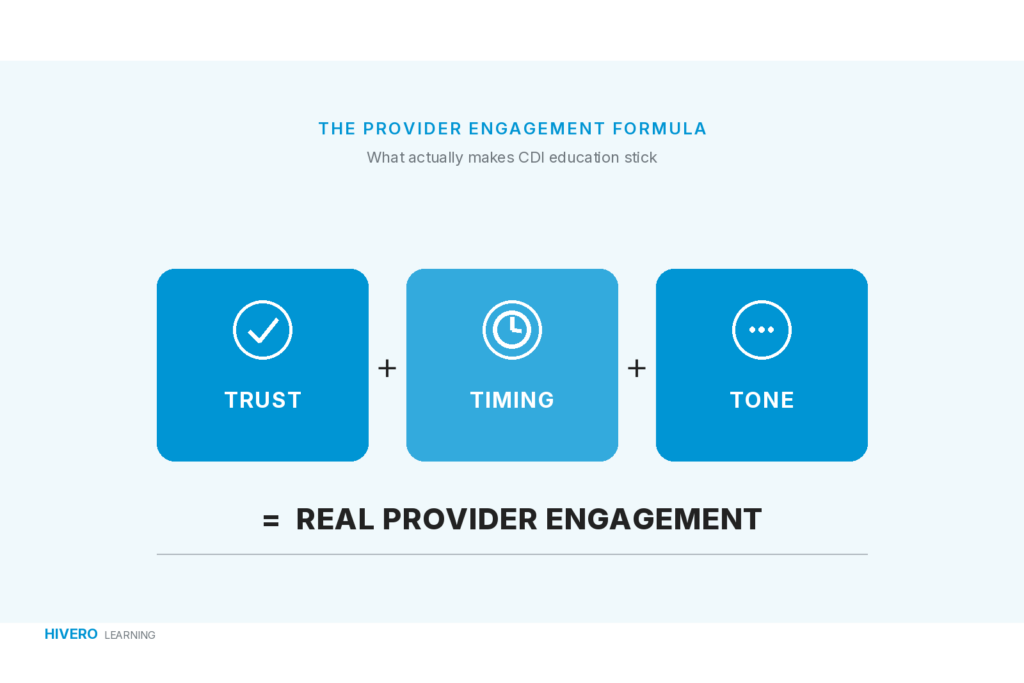
CDI is not just documentation work; it’s relationship work. It’s the ongoing effort to connect clinical thinking, documentation quality, and outcomes in a way that actually reflects the patient’s story. When provider engagement is working, you feel it. Conversations are more productive. Queries feel less transactional. Education has a better chance of landing, not because someone was told what to do, but because there’s a real shared understanding behind it. If CDI education is going to stick, the work has to go beyond content. It has to include trust, relevance, timing, tone, and the relationship beneath it all. Providers engage when CDI feels like a partnership, not a constant source of correction. That’s the hardest part to get right. It’s also the part that matters most.
The next time education doesn’t stick, resist the urge to send one more tip sheet. Instead, step back and consider the experience from the provider’s side. Does the message feel relevant? Does it respect their workflow? Does it sound like support or correction? CDI has more influence than we sometimes realize not because of what we know, but because of how we show up. When that connection is right, education has a chance to finally take hold.