
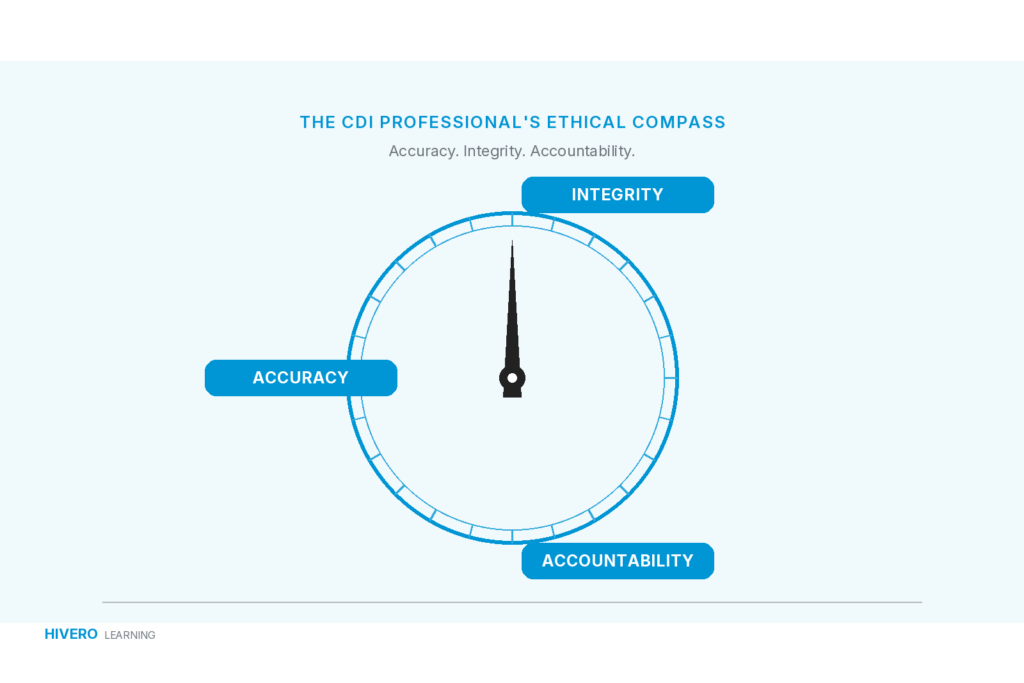
Clinical Documentation Integrity (CDI) is sometimes framed around metrics such as DRGs, severity of illness, risk of mortality, quality scores, and reimbursement. At its core, however, CDI is an ethics-driven profession: we ensure the medical record truthfully reflects the patient’s clinical story through accuracy, integrity, and accountability.
As documentation increasingly supports patient care, regulatory compliance, quality reporting, and public trust, CDI professionals serve as stewards of the medical record. Our responsibility is not to influence outcomes, but to clarify and align documentation with clinical evidence and provider judgment.
Accuracy: Honoring the Patient’s Story
Accuracy is the foundation of ethical CDI practice. Every diagnosis captured, every condition clarified, and every query issued must be supported by clinical evidence and physician judgment. Accurate documentation ensures that the medical record reflects the patient’s condition, the complexity of care provided, and the clinical decision-making that occurred.
For example, when a progress note lists “respiratory distress” but ABGs, increasing oxygen needs, and a pulmonary consult support acute hypoxic respiratory failure, an evidence-based query can clarify the diagnosis, so the record reflects the true clinical picture.
This work requires more than a surface-level review. CDI professionals must apply critical thinking by connecting clinical indicators, reviewing the entire encounter, and recognizing when documentation does not yet reflect the true severity of illness or risk of mortality. Accuracy is not about maximizing DRGs or capturing the highest-weighted diagnosis; it is about representing clinical reality.
When we prioritize accuracy, we protect patients, physicians, and organizations. We support appropriate care continuity, reliable data, accurate coding, and meaningful quality reporting. Most importantly, we uphold the integrity of the patient’s clinical narrative.
Integrity: Doing the Right Thing, Even When It’s Hard
Integrity is tested in the gray areas of CDI practice. These are the moments when pressure exists, whether related to financial performance, quality metrics, or external scrutiny, and ethical judgment matters most.
Ethical CDI practice means:
- Never directing documentation for financial or reporting gain alone
- Avoiding assumptions or unsupported diagnoses
- Respecting provider autonomy and clinical judgment
- Issuing queries that are clear, compliant, and clinically grounded
Compliant querying is one of the clearest expressions of professional integrity. A well-crafted query is not leading or suggestive; it is clarifying. It presents relevant clinical facts, identifies inconsistencies or gaps, and allows the physician to determine the appropriate documentation based on their clinical assessment.
For example, if leadership is focused on improving a quality measure, integrity means you query only when clinical indicators support clarification (e.g., asking for the specificity of encephalopathy when documented findings are present), not to “reach” for a preferred diagnosis.
Integrity also extends to validation. Clinical validation is not about challenging providers; it is about ensuring diagnoses are supported by clinical evidence and align with accepted definitions and guidelines. When performed thoughtfully and collaboratively, validation strengthens trust and reinforces CDI’s role as a partner in documentation excellence.
Accountability: Owning Our Professional Responsibility
CDI professionals are accountable not only for what we query, but for why we query and how we engage. Our work influences downstream coding, reimbursement, public reporting, and organizational credibility. With that influence comes responsibility.
For example, when a provider repeatedly documents a condition that lacks supporting evidence, accountability may require a respectful clinical validation discussion, and if patterns persist, escalation through established compliance channels.
Accountability means:
- Following official coding guidelines and regulatory standards
- Applying policies consistently and transparently
- Escalating concerns when documentation or practices raise ethical red flags
- Committing to continuous education and professional growth
It also means recognizing that CDI does not operate in isolation. Collaboration with coding, quality, utilization management, compliance, and providers is essential to maintaining a unified, ethical approach to documentation. When CDI professionals act as trusted collaborators, we help create a culture where accuracy and integrity are shared values, not competing priorities.
CDI as a Trusted Steward of the Medical Record
CDI is a professional discipline rooted in ethics and dedicated to protecting the integrity of the health record.
CDI professionals safeguard the patient record. We ensure that DRGs reflect true complexity, that risk adjustment is clinically justified, and that quality data accurately represents the care delivered. We bring clarity to complexity and accountability to documentation. In doing so, we elevate the profession.
A Call to Professional Purpose
As CDI evolves, our ethical compass must stay practical and visible in daily work. Technology will change and expectations will rise, but accuracy, integrity, and accountability remain the standard that protects the clinical record.
Put that standard into action by using a brief “compass check” before every query:
1.) Is my request evidence-based and complete? (Accuracy)
2.) Is it neutral, compliant, and free of outcome-driven wording? (Integrity)
3.) Am I prepared to stand behind the rationale, educate when needed, and escalate appropriately? (Accountability)
When we apply this compass consistently, we strengthen trust in the record and in the CDI profession.