
Clinical accuracy is the starting point for everything we do in CDI. Before queries. Before DRG optimization. Before quality metrics. If the clinical picture isn’t solid, nothing else holds up.
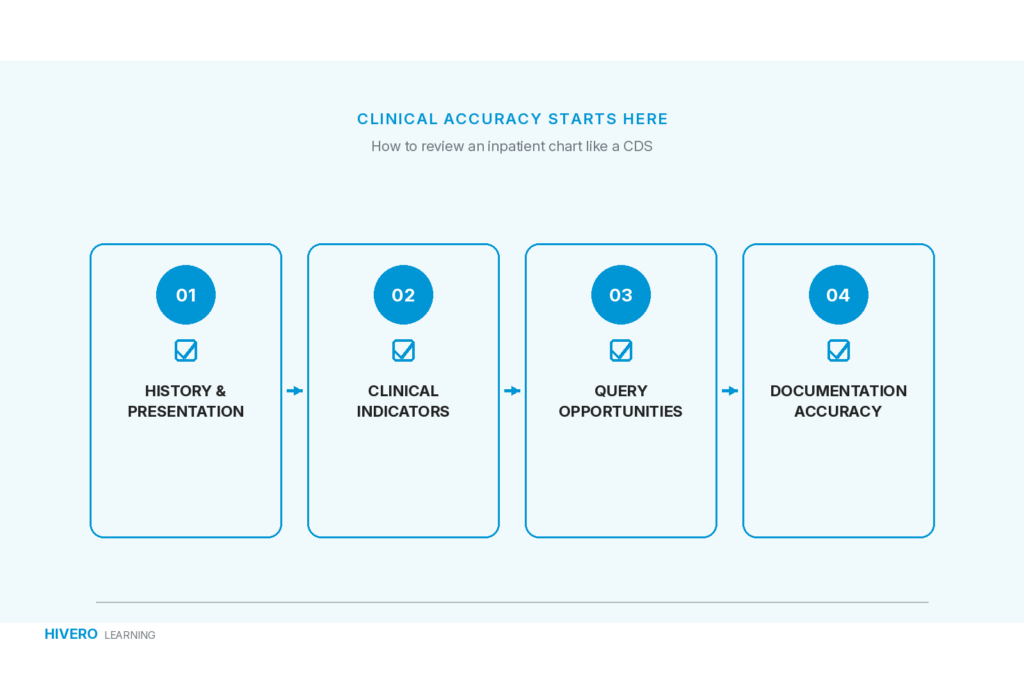
For a Clinical Documentation Specialist (CDS), reviewing an inpatient chart isn’t about hunting for diagnoses or checking boxes. It’s about understanding the patient’s story, what brought them in, what’s happening clinically, and whether the documentation supports it from start to finish.
This article walks through how to review an inpatient chart the way a CDS thinks: how to break down the medical record, what to look for in key notes, and how to train your brain to spot gaps, inconsistencies, and missed opportunities.
Start With the Big Picture: Understanding the Medical Record as a Whole
One of the biggest mistakes new (and even experienced) CDI professionals make is reviewing documentation in isolation. A diagnosis shows up in one note, labs are buried somewhere else, and treatment lives in a different section altogether.
The inpatient chart is one continuous story. The role of the CDS is to connect the dots.
At a high level, that story usually includes:
- The History & Physical (H&P)
- Daily progress notes
- Consult notes
- Labs, imaging, and diagnostics
- Medications and treatments
- The discharge summary
Instead of asking, “What diagnoses are listed?” a CDS asks:
“Does the documentation consistently and clinically support the patient’s condition throughout the encounter?”
That shift in mindset is where clinical accuracy really starts.
The History & Physical (H&P): Establishing the Baseline
The H&P is your baseline. It tells you why the patient is here and what the provider was thinking at the time of admission.
When you review the H&P, slow down and focus on:
- Why the patient came in – Are the symptoms clear and clinically meaningful?
- Relevant history – Does the past medical history add context or risk?
- The assessment and plan – Do the documented diagnoses make sense based on the presentation?
As a CDS, you’re not just reading, you’re evaluating. If a significant diagnosis is listed, the H&P should explain why it was suspected or diagnosed at that time.
Progress Notes: Tracking Clinical Evolution
Progress notes are where the story unfolds. They show how the patient responds to treatment, how diagnoses evolve, and whether clinical indicators improve, worsen, or resolve.
When reviewing progress notes, look for:
- Consistency of diagnoses over time – Do documented conditions persist, resolve, or change?
- Clinical indicators – Are labs, vitals, and imaging referenced to support diagnoses?
- Treatment-response alignment – Does the plan of care make sense for the conditions documented?
Progress notes also reveal copy‑and‑paste habits. A diagnosis that made sense on day one may no longer be supported on day three, but it can still show up unless someone is paying attention. That’s where the CDS and critical thinking make a real difference.
Consult Notes: Adding Depth and Validation
If you want some of the clearest clinical reasoning in the chart, look at the consult notes.
Specialists often document with greater precision, making consult notes incredibly valuable for the CDS to review. They can:
- Confirm or clarify diagnoses
- Add specificity
- Rule conditions in or out
When a consultant’s assessment doesn’t align with what’s documented elsewhere, that’s a signal worth exploring. These notes often help validate or challenge the clinical picture.
Training Your Brain: How an Experienced CDS Thinks
Clinical accuracy isn’t just about what you review; it’s how you think. Experienced CDI professionals develop mental shortcuts, simple rules they run through on every chart to stay consistent and clinically grounded, that guide efficient and accurate chart review.
Here are a few core “rules” many CDS professionals utilize without even realizing it:
1. Evidence Comes First
If a diagnosis is documented, the next question is always: Where’s the support?
Vitals, labs, imaging, and provider assessment should line up.
2. Treatment Tells You a Lot
Sometimes the treatment plan says more than the note’s words. The intensity of care often reflects true severity.
3. A Well-Supported Diagnosis is Evident Across the Record
A clinically valid diagnosis usually appears consistently across notes, not just once.
4. What’s Missing Matters
No monitoring, no treatment, no follow‑up? That absence can be just as telling as what is documented.
5. Clinical Understanding Comes Before Coding
Great CDI work starts with clinical knowledge and reasoning. Coding and DRGs follow, but they should never drive the review.
Why This Matters: Building a Strong Clinical Accuracy Foundation
Clinical accuracy isn’t just about compliance; it’s about credibility. It protects providers, supports meaningful data, and ensures documentation truly reflects the care delivered.
For CDI professionals looking to strengthen their chart review approach and sharpen critical and clinical thinking, taking time to revisit the fundamentals can make a meaningful difference. Building a consistent, clinically grounded review process helps support clearer documentation and more confident decision‑making, no matter where you are in your CDI journey.