
When most people think about hospital quality scores, they think about patient safety, infection prevention, nursing care, physician performance, or quality departments. And they’re not wrong. All of those teams play an important role. But there’s another group that often doesn’t get enough credit for its impact on quality outcomes: CDI.
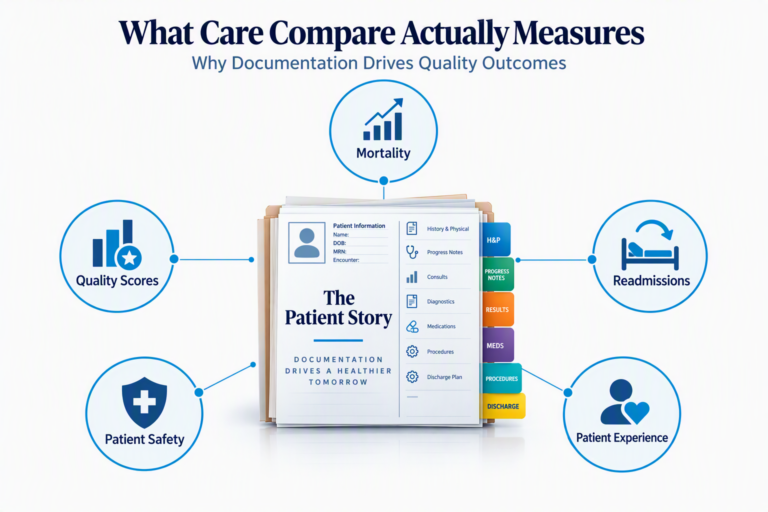
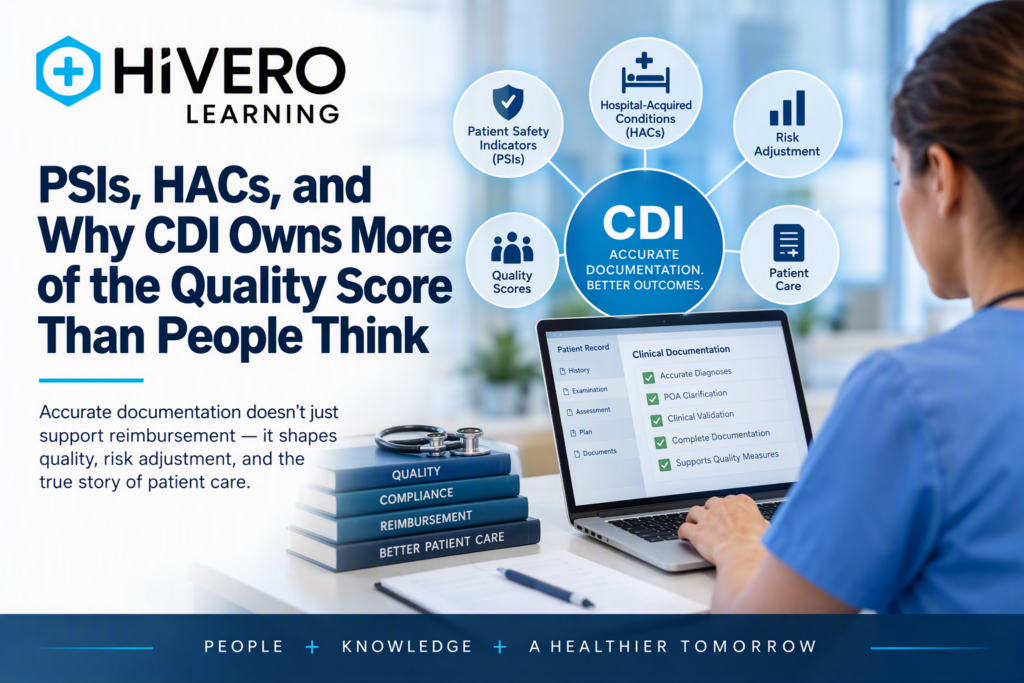
The reality is that many of the measures hospitals are evaluated on today are built from coded data, and coded data starts with documentation. Patient Safety Indicators (PSIs), Hospital-Acquired Conditions (HACs), mortality measures, risk adjustment models, and publicly reported quality scores all depend on how accurately the patient’s story is documented in the medical record. That’s why CDI’s influence reaches far beyond reimbursement and DRGs. CDI helps shape how organizations are measured, compared, and ultimately perceived.
For years, CDI has largely been associated with revenue cycle outcomes. We talk about CCs, MCCs, CMI, and denials. Those things still matter, but the profession has evolved. Today, CDI sits at the intersection of reimbursement, compliance, quality, and patient care. Every time a CDI specialist clarifies a diagnosis, validates a condition, confirms Present on Admission (POA) status, or identifies a documentation gap, they are influencing far more than the final DRG. They are helping ensure the data used to evaluate quality accurately reflects what happened during the patient’s hospitalization.
Take PSIs, for example. These measures are designed to identify potentially preventable complications and adverse events using claims data. On the surface, they look like purely clinical quality measures. But anyone who has spent time in CDI knows that many PSI opportunities are really documentation opportunities. Was the condition truly hospital-acquired? Does an exclusion apply? Was it present on admission? Is the diagnosis clinically supported? Was the provider’s documentation specific enough to accurately depict the patient’s condition? Those questions often determine how a case is reported long before it appears on a quality dashboard.
The same can be said for HACs. Most people associate HACs with payment penalties, but they’re really about making sure the clinical story is accurate. A pressure injury that was present on admission is very different from one that developed during a hospital stay. A postoperative event may represent an expected outcome, while another may truly be a complication of care. Without clear documentation, quality measures may not reflect what actually occurred. CDI professionals help bridge that gap by working with providers to ensure the record tells the complete and accurate story.
Risk adjustment is another area where CDI’s impact is often underestimated. Hospitals are increasingly evaluated using observed-to-expected comparisons for mortality, complications, LOS, and other outcomes. The expected side of that equation depends on documented patient complexity. If the record doesn’t capture the full severity of illness or risk of mortality, the organization can appear to have worse outcomes than it actually does. That’s why documentation for conditions such as acute respiratory failure, septic shock, acute kidney injury, and malnutrition matters so much. These diagnoses don’t just affect reimbursement. They help explain how sick the patient truly was and provide critical context for evaluating outcomes.
Of course, quality and ethics must always go hand in hand. The goal of CDI is never to manipulate metrics or document our way out of a performance problem. The goal is accuracy. Our responsibility is to ensure conditions are clinically supported, documentation is complete, and the medical record accurately reflects the care that was delivered. Good documentation doesn’t change the patient’s story. It makes sure the story is told correctly.
As healthcare continues to focus on value-based care and publicly reported outcomes, CDI’s role in quality will only continue to grow. We influence PSIs, HACs, mortality measures, risk adjustment, and many of the metrics that appear on quality dashboards. But if we’re being honest, those metrics aren’t the most important thing CDI impacts. The most important thing we influence is the accuracy of the medical record for the patient. Long after quality scores are updated and reimbursement has been finalized, the medical record remains. It tells the story of the patient’s health, guides future care decisions, supports continuity across providers and settings, and serves as a permanent account of what occurred during the hospitalization. Quality scores matter. Organizational performance matters. But those outcomes are really the byproduct of something much more important: ensuring the medical record accurately reflects the patient, their condition, and the care they received. When CDI keeps that mission at the center of its work, better quality scores often follow.