
If you’ve worked in CDI, coding, quality, or revenue integrity for any length of time, you’ve probably heard someone in a meeting say, “We need to improve our Care Compare scores.” Everyone nods. Everyone agrees it’s important. And then, if we’re being honest, some people in the room are silently wondering exactly what Care Compare measures in the first place.
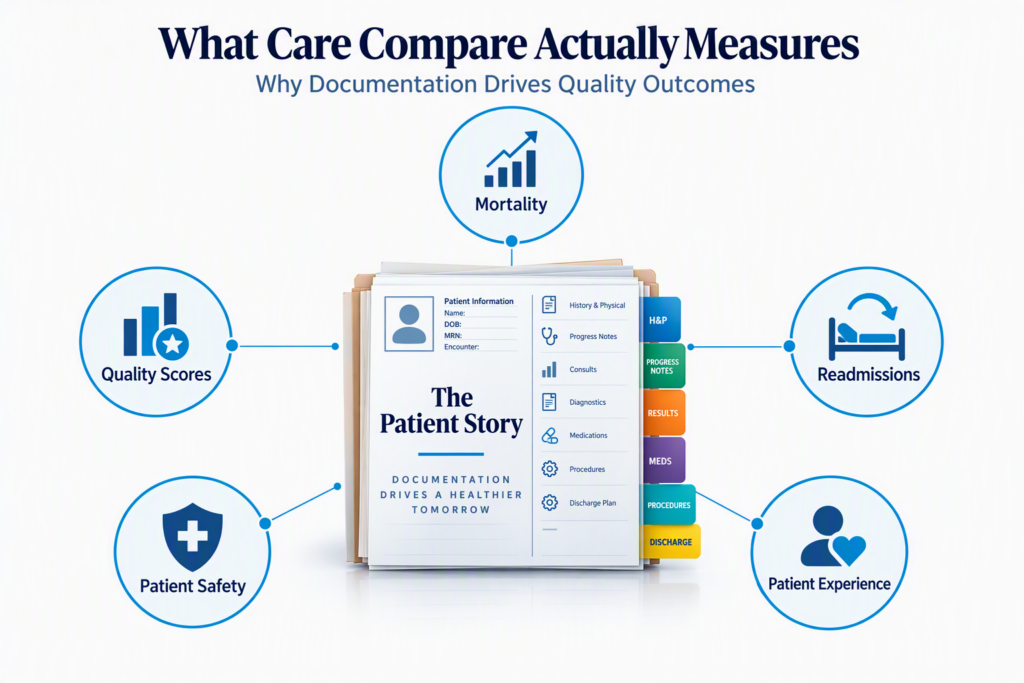
Care Compare is much more than a public report card for hospitals. CMS uses Care Compare to share hospital quality information with patients, employers, payers, and the public. The platform includes information related to mortality, readmissions, patient safety, patient experience, care coordination, efficiency, and other quality outcomes that help consumers compare healthcare organizations.
What many healthcare professionals don’t realize is that behind almost every quality score sits something very familiar to CDI and coding professionals: documentation.
At first glance, Care Compare seems to measure outcomes. Did patients survive? Did they return to the hospital within 30 days? Did complications occur? How did patients rate their experience? Those seem like straightforward questions, but healthcare is rarely that simple.
Consider two hospitals: one serves a relatively healthy population, while the other treats many indigent patients with multiple chronic conditions, advanced disease, and greater clinical complexity. Should both be held to the same standards despite these significant differences? Probably not. That is why risk adjustment exists.
Risk adjustment attempts to account for patient severity and complexity when evaluating outcomes such as mortality, readmissions, and complications. The challenge is that risk adjustment can only work with the information available in the medical record. If a condition isn’t documented, it can’t be coded. If it isn’t coded, it typically isn’t reflected in the risk-adjustment model. In other words, quality scores can only be as accurate as the documentation that supports them.
Think about a patient admitted with sepsis. Sounds straightforward enough until you learn the patient also has acute respiratory failure, severe protein-calorie malnutrition, stage 4 chronic kidney disease, chronic systolic heart failure, and significant functional decline. Suddenly, we’re talking about a very different clinical picture.
If those additional conditions are clinically present but not fully documented, the patient may appear far less complex on paper than they actually were. The expected mortality, expected complications, and expected resource utilization may all be understated. As a result, outcomes that were entirely appropriate for a highly complex patient can look worse than expected.
The patient didn’t change. The care didn’t change. Only the story being told about the patient changed. That’s where CDI enters the picture.
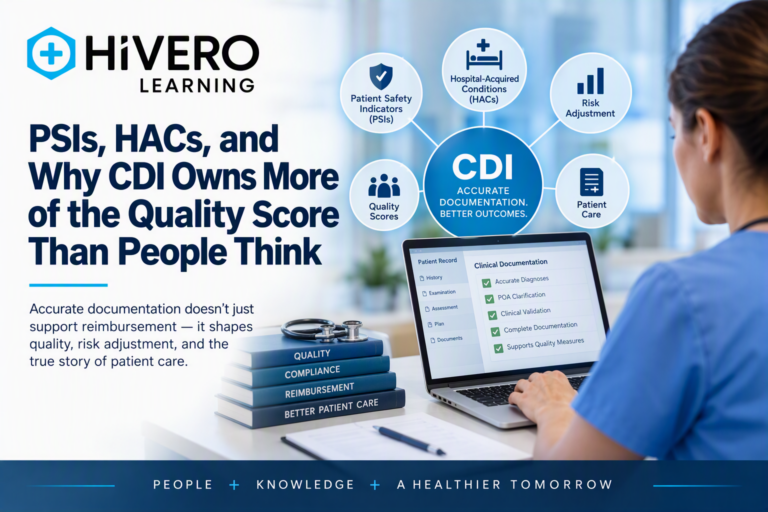
One of the biggest misconceptions about CDI’s impact on quality metrics is the idea that CDI exists to improve scores. The real goal is much simpler and much more important. CDI helps ensure that quality measures accurately reflect the reality of the patient’s clinical journey. When diagnoses are fully documented, clinical indicators support reported conditions, and coding accurately captures the patient’s severity of illness, quality metrics become more meaningful because they’re based on a complete picture of the encounter. That isn’t gaming the system. That’s making sure the system has the information it needs to evaluate performance fairly.
Patient safety measures provide another example of why documentation matters. Many hospital safety metrics rely heavily on coded data. Present-on-admission indicators, complication reporting, and patient safety measures all depend on clear and complete documentation. A condition that existed when a patient arrived can look very different from one that developed during hospitalization if the documentation doesn’t clearly establish the timeline.
To put it another way, if documentation were a witness in court, we’d want it to be detailed, credible, and able to answer questions confidently. Not the witness who shrugs and says, “I think that’s what happened.”
What’s particularly interesting is that patients never see the work that goes into creating these quality metrics. They don’t see documentation reviews, physician education efforts, coding validation discussions, or the carefully written query that went out at 4:47 on a Friday afternoon. What they do see are mortality rates, readmission metrics, patient experience scores, safety indicators, and overall quality ratings that contribute to how a hospital is perceived by the public. In many ways, the work of CDI and coding is invisible. The impact is not.
For years, CDI was often viewed primarily through the lens of reimbursement. Today, that perspective is far too narrow. Every clarified diagnosis, every supported query, every accurate code assignment, and every captured comorbidity contributes to the quality data that hospitals use to demonstrate the complexity of the patients they treat and the care they provide. Documentation influences public reporting, benchmarking, risk adjustment, quality scores, and organizational reputation.
The truth is that Care Compare isn’t simply measuring hospital performance. It’s measuring hospital performance as represented through documented and coded data. That’s an important distinction for every CDI and coding professional to understand.
At the end of the day, CDI isn’t about helping a hospital look better. It’s about helping the data tell the truth. Every quality measure, every risk-adjustment model, and every publicly reported outcome starts with the medical record. When documentation accurately reflects the patient’s condition, clinical complexity, medical decision-making, and response to treatment (something missing in far too many medical records), the resulting quality data becomes far more meaningful.
And perhaps that’s the most important takeaway of all. Above reimbursement, rankings, ratings, and quality scores, what we owe the patient is an accurate representation of their story. Everything else starts there.