

Budget season has a way of exposing what an organization really knows about its revenue cycle.
As FY2027 budgets are being developed, health system leaders are looking for opportunities to improve revenue, reduce leakage, manage costs and protect margins. They have dashboards, reports, benchmarks and more data than most people could reasonably consume before lunch.
And yet, ask a simple question, “Where exactly is the revenue cycle breaking down, and why?”, and the answer is often less clear.
I have spent roughly 30 years working across healthcare, including both the provider and vendor sides of the revenue cycle. One thing I’ve learned is that there is a meaningful difference between an RCM assessment and an RCM diagnostic.
An assessment can identify an opportunity.
A diagnostic should explain the problem.
That distinction matters because the solution you choose depends on understanding what is actually broken.
Why Most Assessments Tell You What You’d Buy, Not What’s Broken
Most vendor assessments aren’t necessarily wrong. They’re simply designed through a particular lens.
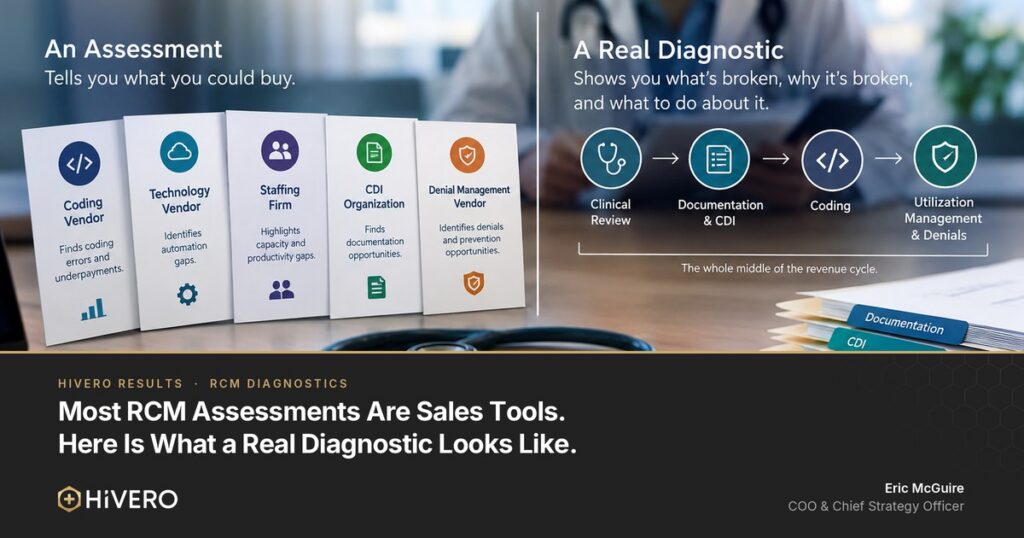
A coding company looks for coding errors. A technology company looks for opportunities to automate. A staffing company identifies capacity and productivity gaps. A CDI organization identifies documentation opportunities. A denial-management company finds denials and opportunities to prevent them.
Each may produce a perfectly legitimate finding.
The problem occurs when an executive tries to assemble those individual findings into a picture of the entire revenue cycle.
One assessment says coding is the problem. Another says documentation. Another says staffing. Another says technology.
Suddenly, the health system has three or four answers that don’t quite add up.
An assessment can be accurate and still be diagnostically incomplete.
The purpose of a true diagnostic isn’t to identify the problem that happens to match the solution being sold. It is to determine where the breakdown occurs, why it occurs, what financial and quality impact it creates, and what intervention addresses the underlying cause.
That requires looking across the revenue cycle rather than through a single departmental lens.
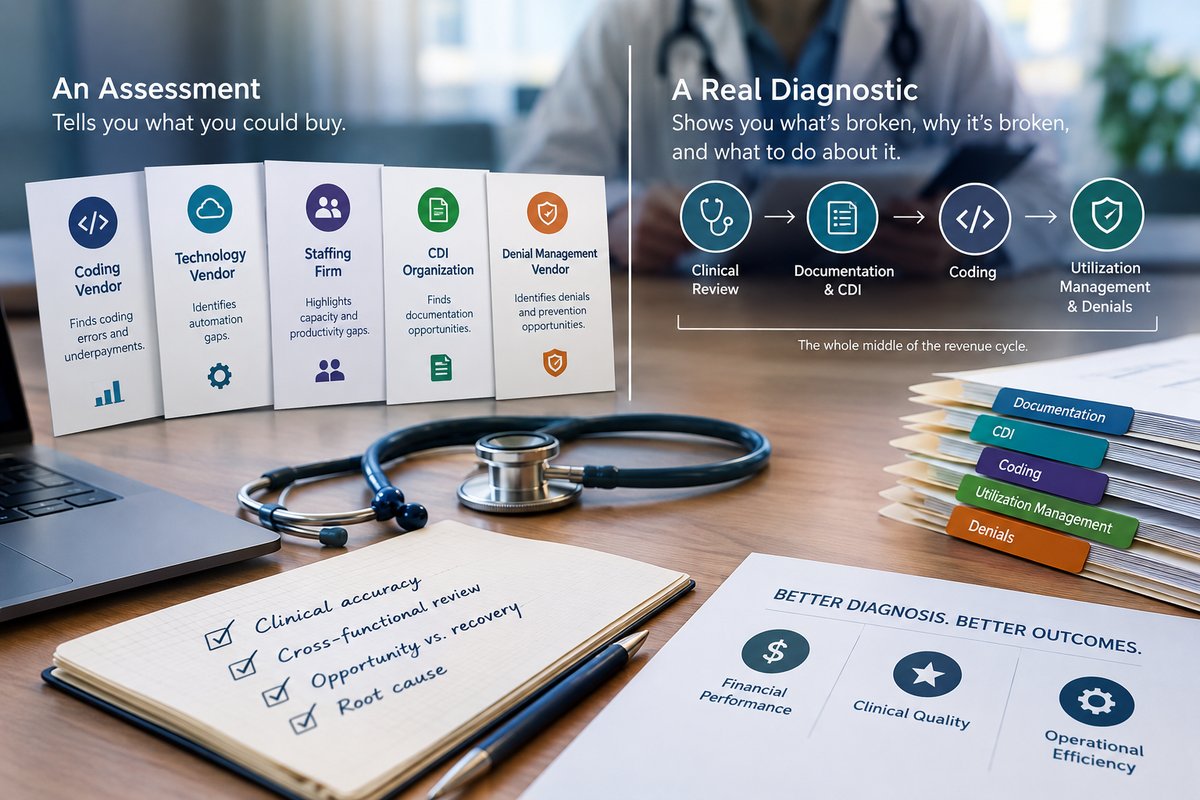
What “Appropriate” Means: Four Tests
So what should an appropriate RCM diagnostic actually look like?
I would suggest four tests.
1. It is clinical, not just coding.
A chart is more than a collection of codes.
If the objective is to understand whether the revenue cycle accurately represents the care provided, someone needs to understand the clinical story contained in the medical record.
That means reviewing the chart itself and understanding the relationship between the patient’s condition, the care delivered and the documentation supporting that care.
A coding audit can tell you whether a code was assigned correctly.
A clinical diagnostic asks a broader question:
Does the record accurately reflect the patient’s clinical condition and the care that was provided?
Those are related questions, but they are not the same question.
2. It looks across the middle of the revenue cycle.
Documentation, CDI, coding, utilization management and denials are often managed as separate functions.
The patient, unfortunately, has not agreed to respect those organizational boundaries.
The financial impact frequently occurs at the handoffs between those functions.
A documentation gap can become a coding issue. A coding issue can contribute to a denial. A utilization-management issue can compound the problem. By the time the organization sees the financial consequence, the original cause may be several steps upstream.
A meaningful diagnostic therefore needs to evaluate those connections rather than evaluating each department in isolation.
3. It separates identified opportunity from promised recovery.
This may be the most important distinction of all.
If a diagnostic reviews a defined sample of charts and identifies a financial opportunity, that is an observation based on the charts reviewed.
It is not automatically a guarantee that the organization will recover the entire amount across its entire patient population.
There is a difference between identified opportunity, extrapolated opportunity and realized improvement.
A credible diagnostic makes that distinction clear.
The goal isn’t to produce the biggest possible number. It is to produce a number the executive team can understand, challenge and ultimately measure against actual results.
4. It identifies root cause.
This is where diagnostics become particularly valuable.
Suppose a coding review identifies a recurring documentation issue. The instinct may be to add more coding resources or increase coding education.
But what if the problem begins with the provider’s initial documentation?
Adding resources downstream may help correct the symptom without fixing the cause.
The diagnostic should determine whether the appropriate intervention is provider education, CDI intervention, coding resources, workflow redesign, technology, staffing or some combination.
Diagnosis should determine intervention.
How the RCM Diagnostic Program Applies These Tests
We built the RCM Diagnostic Program around those four tests, not after them.
It starts with sampling, not a hand-picked chart review. We draw a random, DRG-proportional sample from the full discharge population under review, not a cohort someone suspected had problems going in. That is what makes the output evidence instead of anecdote. Findings from a representative sample can be annualized against the facility’s actual volume and defended in front of a CFO or an audit committee. Findings from a cherry-picked one cannot.
One sample, reviewed by clinicians, covers CDI, medical coding, provider documentation and any add-on or seasonal-program capture concurrently. There is no separate coding assessment stapled to a separate CDI assessment stapled to a separate documentation review. The same charts get read once, by reviewers trained to see the clinical story, the coding accuracy and the documentation gap in the same pass. That is where the handoffs described above actually get examined, instead of assumed away.
The engagement doesn’t presuppose its own answer. It produces a findings report, an encounter-level data workbook showing the evidence behind every number in that report, and an executive working session to walk through what was actually found. Whether the recommendation that follows is more provider education, a CDI intervention, coding resources, workflow redesign or additional staffing, it comes out of what the findings show, not out of which service happens to be for sale.
None of it requires offshore system access. A single encounter-level data export is enough to build the random sample; reviewing the charts themselves means reaching the medical record, coordinated with the health system’s HIM team once the sample is drawn. A defined window, typically six to eight weeks from the data landing, is enough to run the review, synthesize the findings and deliver the readout. And running the diagnostic doesn’t commit a health system to anything beyond it. If the findings support an ongoing program, that gets proposed separately, priced from what the diagnostic actually found, not from what a template assumed going in.
That is the difference this piece keeps circling back to. An assessment sells a next step. A diagnostic earns the right to recommend one.
What a Real Diagnostic Can Find
When the review is appropriately structured, the results can be significant.
Across our OB/Newborn reviews, covering hundreds of charts, 60% of the OB charts reviewed contained documentation or coding issues. The associated documentation gaps represented an estimated $7.5 million to $8.2 million in extrapolated annualized financial impact.
That wasn’t a theoretical exercise. The reviews showed where the documentation and coding issues were occurring and provided a basis for determining how they could be addressed.
In newborn cases, we also found examples where patients classified as normal newborns under DRG 795 could appropriately move to a different DRG when the medical record documented the monitoring and evaluation actually being performed.
The point isn’t that every chart should move to a higher-paying DRG.
The point is that the medical record should accurately represent the patient’s condition and the care provided.
In another structured review, the organization realized a $1.16 million lift in the first half of 2026, along with a 5.71% improvement in CMI.
None of these outcomes required changing the volume of patients or changing the clinical care being delivered.
The opportunity came from better identifying and capturing what was already happening.
That distinction matters.
The objective of an appropriate diagnostic is not to manufacture revenue. It is to determine whether the existing clinical record accurately reflects the care that has already occurred.
The Quality Half of the Equation
The financial implications are relatively easy to understand. The quality implications deserve equal attention.
Clinical documentation doesn’t just influence reimbursement. It also contributes to how a patient’s severity and risk are represented in the data used for quality measurement and risk adjustment.
When acuity is under-documented, the resulting data can understate the complexity of the patients being treated.
That can affect measures involving severity of illness, risk of mortality, risk-adjusted mortality and other quality measures that depend on accurate clinical and coded data.
This creates an uncomfortable possibility: the same documentation gap can create a financial problem and make an organization’s performance appear different from the clinical reality.
That is why the conversation about documentation should not be limited to “How much additional reimbursement can we generate?”
A better question is:
Are we accurately representing the patients we treat, the care we provide and the outcomes we achieve?
The financial result is important. So is getting the clinical story right.
A Diagnosis Should Lead Somewhere: Diagnose, Educate, Staff
A diagnostic that ends with a 60-page report and a meeting isn’t much of a diagnostic.
It is an expensive souvenir.
The purpose of diagnosis is to determine what should happen next.
Sometimes the answer is education. If the root cause is a documentation behavior, the most effective intervention may be educating providers at the point where the documentation begins.
Sometimes the answer is additional staff. If the organization has a genuine capacity or expertise gap, the solution may require additional CDI, coding, utilization-management or other resources.
And sometimes the answer is technology.
But technology should not be the first answer simply because it is the newest answer.
The sequence should be straightforward:
Diagnose → Educate → Staff → Measure
First, determine where the problem actually exists.
Then address the root cause.
Then add the resources necessary to manage what remains.
Finally, measure whether the intervention produced the expected financial, operational and quality outcomes.
That approach changes the conversation from “What can you sell me?” to “What does my revenue cycle actually need?”
As FY2027 budgets come together, that may be the more important question for health system leaders to ask.
The next time someone offers to assess your revenue cycle, look beyond the opportunity number.
Ask whether the assessment can answer four questions:
- Was it clinically informed?
- Did it look across the revenue cycle rather than a single function?
- Did it distinguish identified opportunity from projected recovery?
- Did it establish root cause?
If it can, you may have more than an assessment.
You may actually have a diagnosis.