
Ask an RCM tech vendor what their platform delivers, and you’ll hear the same line every time: a “20% to 30% boost in operational efficiency.”
Now ask a CFO or VP of Revenue Cycle sitting on the provider side to point to the hard dollars saved or generated on their income statement from that exact tool.
Crickets. Or at best, a hesitation and a pivot to softer metrics.
I’ve sat on both sides of this table—spending three decades managing provider operations and scaling vendor solutions. Over my career, including building seven new clinical RCM service lines from the ground up at a $100M+ PE-backed enterprise, I’ve seen this script play out constantly.
We are watching a massive disconnect between the promise of healthtech AI and the actual cash-flow reality on the ground.
And as revenue cycle consolidation accelerates, the operators who survive won’t be the ones holding the longest list of AI software licenses. They’ll be the ones who mastered the discipline of proving real ROI.
Measuring Vanity Instead of Value
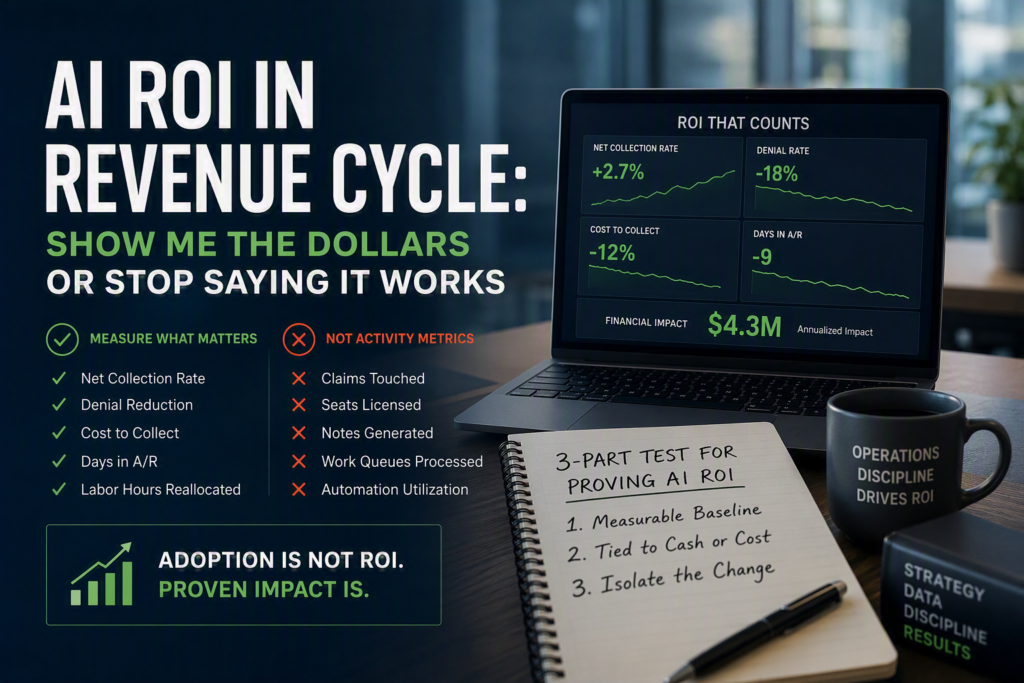
The core issue isn’t that AI technology doesn’t work. The issue is that most organizations measure adoption instead of outcome.
Vendor pitch decks love vanity metrics:
- “Over 1 million claims touched by our engine!”
- “85% clinical chart scan rate!”
- “100 user seats fully licensed and onboarded!”
None of these metrics pay the bills. In fact, tracking activity instead of dollars is a dangerous liability—it masks stagnant or deteriorating core performance under the guise of technological progress.
When you’re accountable to a Board or a Private Equity sponsor, “claims touched” doesn’t increase your valuation. Net collection rate does. Lowering days in A/R does. Permanently reducing cost-to-collect does.
Where AI Actually Delivers (And Where It’s Overhyped)
If you want real ROI today, you must separate the practical workhorses from the expensive science projects.
Here is my field report on what’s actually moving the needle:
Underhyped & High Impact: Clinical Denial Prevention & Appeal Drafting This is where clinical judgment meets automation. AI models trained to analyze payer medical-necessity policies against complex clinical documentation can flag a potential denial before the claim ever leaves the door. On the back end, generating highly contextual, evidence-backed appeal letters significantly cuts nurse auditor review times. This drives direct, measurable yield on cash collections.
High Potential, Conditional ROI: Prior Authorization Automation. Prior auth is an operational nightmare, making it a prime target for automation. Tools that auto-extract clinical requirements, check payor portals, and track authorization statuses work remarkably well. But the ROI evaporates quickly if your team doesn’t re-engineer the clinical workflow around the tool. Automating a broken process just gives you faster bad submissions.
Overhyped Today: Fully Autonomous Coding for Complex Inpatient Cases. Simple, low-acuity outpatient charges? Sure, ambient and autonomous tools handle those adequately. High-acuity, multi-specialty inpatient cases? Not yet. Promising 90%+ pure autonomous coding on complex clinical charts without heavy human-in-the-loop validation leads to compliance exposure and massive spike rates in payor audit rejections.
Why Most AI Deployments Fail the ROI Test
When an AI investment fails to produce hard returns, leaders tend to blame the software. But ROI isn’t primarily a technology selection problem—it’s a measurement and operational discipline problem.
The failure usually comes down to four systemic traps:
- Garbage In, Garbage Out: Legacy EHR data is messy, unstructured, and fragmented. Feeding unstructured clinical notes into an advanced algorithm won’t magically produce clean revenue cycle outputs.
- No Baseline Control Group: Organizations deploy a tool across an entire department, then attribute any subsequent lift in cash to the software. Meanwhile, payor mix changed, volumes shifted, or a new billing manager took over. Without an isolated baseline, ROI claims are pure guesswork.
- Misaligned Vendor Incentives: Vendors sell software licenses or user seats; you manage cash collections and operating margins. If a vendor isn’t willing to tie their fee structure to validated financial outcomes, they aren’t your operational partner—they’re just a line item expense.
- Change Management Inertia: Staff members often don’t trust the technology. If a CDI specialist or coder spends three minutes double-checking an AI suggestion that took two seconds to generate, your net efficiency gain is zero.
A 3-Part Framework for Proving Real AI ROI
To cut through the noise, we use a straightforward, 3-part test to evaluate operational technology. Before claiming success on any AI implementation, require your team to answer these three questions:
1. Was there an audited baseline before deployment? You cannot measure lift if you don’t know your exact starting point. Establish a 90-day pre-deployment baseline for cost-per-chart, turnaround time, first-pass pay rate, or denial volume.
2. Is the target metric directly tied to cash or cost? Ignore activity metrics like “charts scanned” or “clicks saved.” The target metric must be a financial reality: lower FTE cost per account, reduced write-offs, or accelerated cash velocity.
3. Is the financial gain isolated from operational noise? Validate that the ROI came from the technology rather than external variables. Run controlled pilots across comparable sub-specialties or regional teams before a full rollout.
[ Baseline Control ]
│
▼
[ Cash/Cost Metric Only ]
│
▼
[ Isolated Variable Validation ] ──► Real Financial ROI
What RCM Leaders Must Do Differently
Moving from anecdotal success to audited financial performance requires a structural shift in how executives buy and manage technology.
- Demand Outcome-Based Contracts: Shift risk back to software providers. Tie vendor fees directly to measurable operational hurdles or cash-yield improvements.
- Run 90-Day Controlled Pilots: Stop doing enterprise-wide rollouts on faith. Run small, tightly monitored pilots with fixed baselines and clear kill switches if targets aren’t met.
- Audit AI Reporting Like Revenue Forecasting: Treat vendor-provided efficiency dashboards with healthy skepticism. Validate internal data independently through your finance team, not through the vendor’s portal.
At Hivero, we built this exact operational discipline directly into our business model. Across our clinical services and technology offerings, we deployed a three-tier agentic AI operating framework across our entire leadership structure. Why? Because integrating intelligent execution directly into operational workflows is the only way to deliver audited, bottom-line impact.
The next consolidation wave in revenue cycle management will be unforgiving to passive operators. The winners won’t be the companies boasting about how much AI software they bought—they’ll be the ones who can show, down to the exact dollar, what that AI actually delivered.