
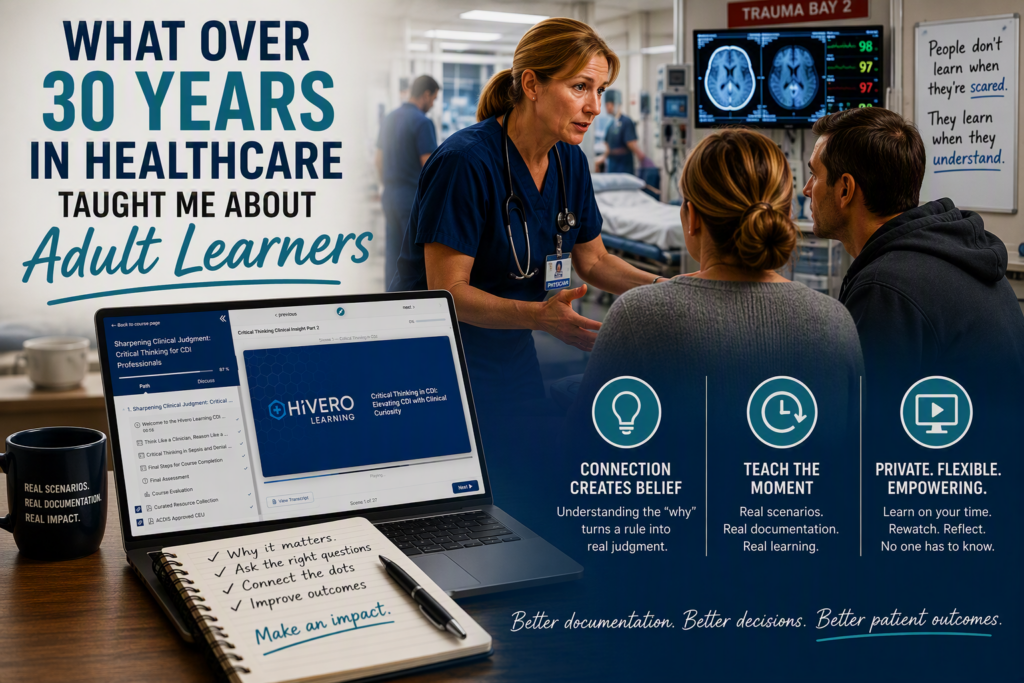
Nothing teaches you how adults actually learn faster than explaining a stroke diagnosis to a terrified family in a trauma bay at 3 AM, while someone’s already pulling up survival statistics on their phone before you’ve finished the sentence. Over 30-plus years in healthcare, emergency medicine most vividly, but plenty of other settings along the way, I did some version of that more times than I can count. Turns out it prepared me for building a CDI course a lot more than I expected.
Here’s the first thing you learn fast in an ER: nobody absorbs anything while they’re scared. It doesn’t matter how simple the concept is. If the person in front of you is convinced the worst is happening, the information bounces right off. I’ve watched that happen with a family member frozen in a hallway, unable to process a word of what I’d just said, and I’ve watched the exact same thing happen in CDI onboarding with a nurse three weeks into their first CDI role, certain they’re the only one in the orientation who doesn’t get a concept. They aren’t. They never are.
Second thing: adults don’t take instructions on faith. You can hand a patient a medication regimen all day long, but it doesn’t actually stick until they understand what happens if they skip a dose. CDI education works the same way. Tell a CDI specialist to “always ask about acuity,” and it’s just a rule to memorize. Show them why an under-documented severity score quietly wrecks a mortality index, and it stops being a rule; it becomes something they actually understand and believe.
Third thing: ER teaching never happens on a schedule. You teach whatever the moment hands you: what an abnormal lab value means, a diagnosis nobody saw coming, a question that only surfaces once someone’s halfway out the door with their discharge instructions in hand. Good CDI training works the same way: less lecture, more “here’s the actual clinical scenario, here’s the actual documentation, what do you notice?” We built the courses around that instinct on purpose, using real clinical scenarios and queries instead of hypothetical ones, because that’s the version that actually lands. It’s also why every course lives online and is self-paced: a nurse or CDS working long hours doesn’t have a syllabus-shaped schedule, and the training needs to be there whenever they actually have the hour to give it, not on a classroom’s clock.
And the last thing years in the ER taught me: nobody wants to be the one who has to ask twice to help reinforce a concept. Online, that turns out to be the advantage, as nobody has to raise a hand at all. Rewind the video, replay the clinical scenario, sit with a tricky query as many times as it takes, and no one in the room ever has to know you needed the extra time.
None of this is groundbreaking if you’ve spent real time teaching. But it’s exactly why the CDI Academy is built the way it is: less “here are the rules,” more “here’s the clinical scenario, let’s walk through the critical thinking it actually takes to work through it.”
It’s one of the many reasons I’m proud of the work our team does at Hivero Learning: combining subject-matter expertise, instructional design, and real-world application to create meaningful learning experiences.