
In July 2020, the OIG told hospitals they had overbilled Medicare by an estimated $1 billion on a single diagnosis: severe malnutrition.
Out of 200 sampled claims, only 27 were billed correctly. The other 173 failed review, most because the documentation couldn’t support the severity level coded.
Every CFO who read that report read it the same way: as a liability. Audit exposure. Recoupment risk. A compliance problem to be contained.
That reading is half right. And the half that’s missing is costing hospitals more than the audits are.
Why the OIG picks the targets it picks
The OIG doesn’t select focus areas at random. It goes where three conditions converge: high dollar impact per claim, high volume, and high documentation variability.
Severe malnutrition is the textbook case. E41 and E43 are MCCs: a single diagnosis code that shifts the DRG and materially changes the payment. Across FY2016–2017, claims carrying those codes represented $3.4 billion in Medicare payments across 224,175 claims.
And the clinical criteria are genuinely hard. Nutrition assessment standards, physician documentation habits, and coding guidelines don’t naturally line up. That misalignment is exactly what makes the diagnosis auditable, and it’s why malnutrition became a recurring federal audit target, with Medicaid reviews following the Medicare audit, and why the OIG’s standing recommendation to CMS is to target reviews at claims billed at the highest severity levels. The diagnosis rotates; the pattern stays on the list.
Here’s the part most finance teams miss: documentation variability doesn’t run in one direction.
The same broken process cuts both ways
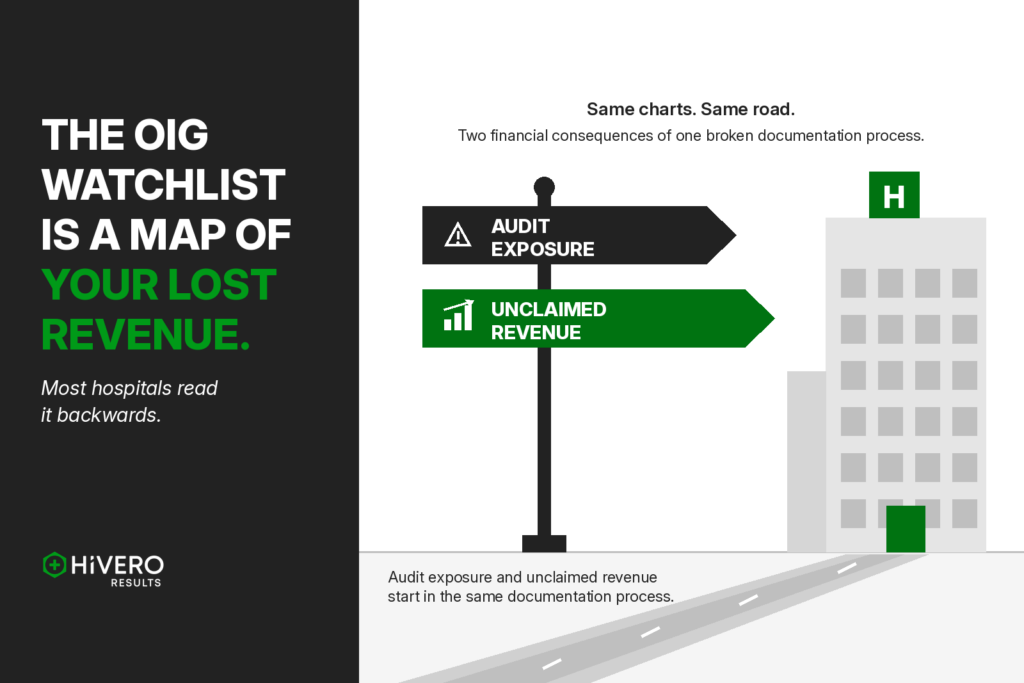
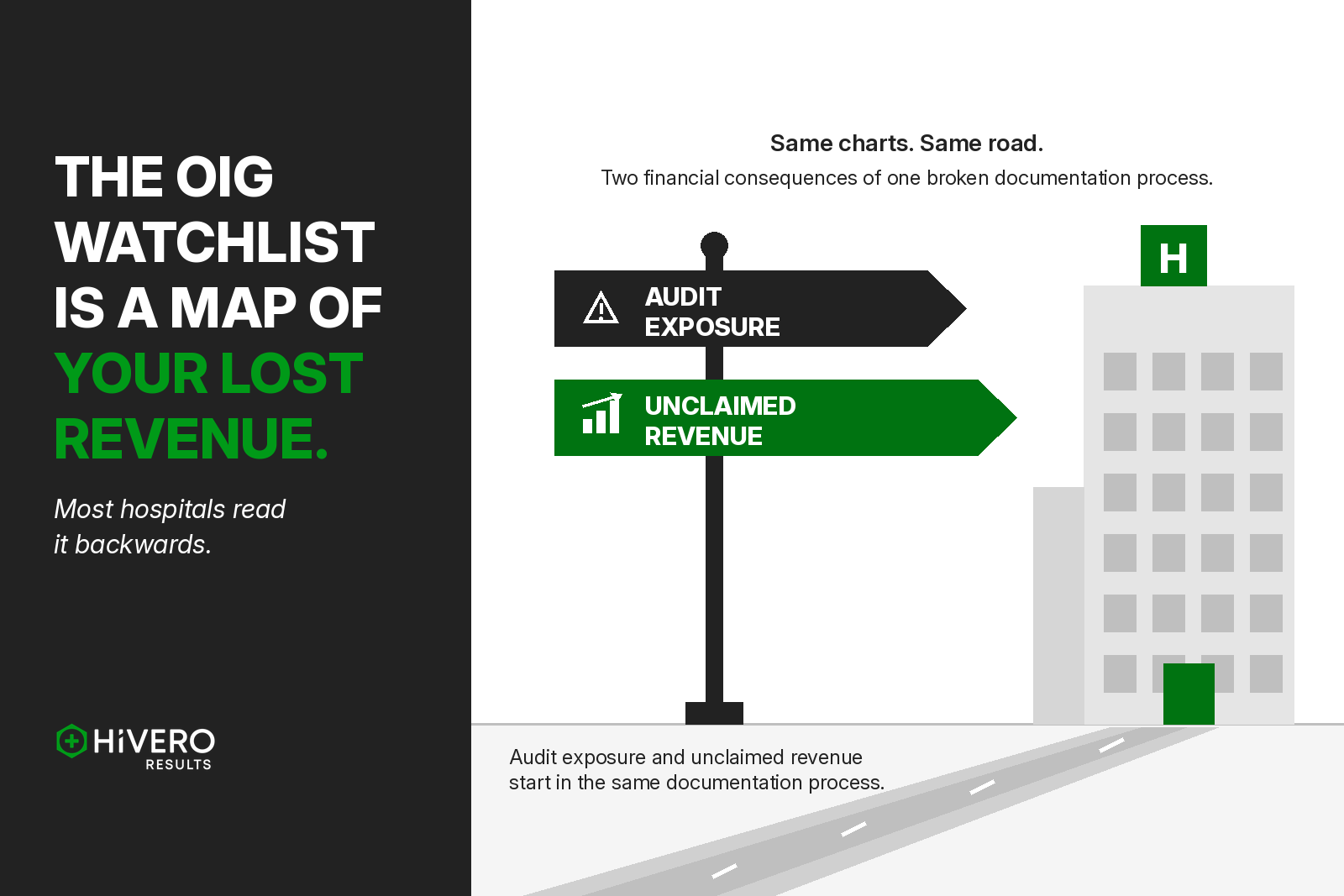
A documentation process that can’t reliably defend severity when it’s coded is the same process that fails to capture severity when it’s real.
If your physicians aren’t documenting the clinical indicators that support a severe malnutrition diagnosis, some of your coded cases won’t survive an audit. That’s the overpayment story the OIG tells.
But that same documentation gap means other patients, ones who genuinely meet severity criteria, are leaving your hospital coded at a lower severity than their care actually reflected. Lower DRG. Lower payment. Lower CMI. Understated expected mortality. Quality metrics that make your outcomes look worse than they are.
Overcoding and undercoding are not opposite problems. They are two outputs of one broken process. The OIG only bills you for one of them. The other one, you pay for quietly, every month, forever.
Denials work the same way. The claims your payers clinically deny are overwhelmingly the ones where documentation doesn’t clearly support the diagnosis. It is the identical weakness the OIG exploits, just monetized by a commercial payer instead of a federal auditor. When your denial rate on a diagnosis climbs, that’s not a payer problem. That’s your documentation process failing a stress test someone else designed.
Revenue integrity and audit risk are the same conversation. Any hospital treating them as separate programs, with a compliance team defending charts, a revenue team working denials, and nobody owning the documentation process underneath both, is funding two teams to lose the same fight.
We’ve measured what the quiet side costs
At Hivero, we run structured documentation reviews across service lines the OIG isn’t headlining, and the error pattern is the same, except the money runs against the hospital.
Take obstetrics and newborn care. Across hundreds of chart reviews in our OB assessment program, we found a 60% coding error rate. Not 6%. Sixty.
The annualized revenue impact of those OB and newborn documentation gaps: $7.5M to $8.2M. That’s legitimate, defensible reimbursement: care that was delivered, monitored, and evaluated, but never documented in a way the coding could capture.
The most common single pattern is almost mundane. Newborns with benign conditions default into DRG 795, normal newborn and minimal payment, when the record doesn’t reflect the monitoring and evaluation that actually occurred. When physicians document that work, those encounters routinely shift into paying DRGs. Nothing about the care changes. Only the record does.
And when the process gets fixed, the results are measurable: one structured OB CDI review program has produced a $1.16M revenue lift year-to-date with a 5.71% CMI impact. Same patients. Same clinicians. Different documentation process.
Now apply that lens back to the OIG watchlist. If a service line nobody is auditing carries a 60% error rate against the hospital, what do you think is happening in malnutrition, sepsis, respiratory failure, the areas where documentation is even harder and the severity stakes are higher? The watchlist isn’t just showing you where you might owe money back. It’s showing you where your documentation process is weakest, which means it’s also showing you where you’re most likely leaving legitimate revenue unclaimed.
Where the breakage actually lives
In our assessment work, these failures trace to three gaps, and they compound.
A process gap. Clinical criteria, physician documentation, CDI review, and coding operate as handoffs rather than a system. Queries go out late or not at all. Nobody reconciles what the nutritionist assessed against what the physician documented against what the coder could code.
An education gap. Physicians were never trained to document to criteria, and CDI teams are often working from outdated or inconsistent clinical definitions. The gap between what happened clinically and what’s defensible on paper is an education problem before it’s a coding problem.
A staffing gap. Experienced CDI specialists are scarce, expensive, and unevenly deployed. Most hospitals can’t staff deep specialty coverage in OB, pediatrics, or quality-focused review, so those service lines simply never get looked at. The 60% error rate isn’t a talent failure. It’s a coverage failure.
Any vendor selling you a fix for one of the three is selling you a third of a solution.
The CFO takeaway
Stop reading the OIG watchlist as a list of things to fear. Read it as free diagnostic intelligence: the federal government has already told you which diagnoses have the widest gap between clinical reality and documented record.
Then ask the question the OIG won’t ask for you: in those same areas, and in the service lines nobody audits, how much legitimate severity are we failing to capture?
Most hospitals cannot answer that question with data. The ones that can are recovering seven figures, defensibly and compliantly, with quality metrics that finally reflect the care they actually deliver.
If you want the answer for your organization, that’s exactly what a Hivero CDI assessment is built to produce: a baseline read of your documentation accuracy, the audit exposure and the unclaimed revenue sitting in the same charts, and a prioritized path to fix the process underneath both. Reach out to the Hivero Results team to request an assessment, before the next Work Plan update reads your charts for you.
Eric McGuire is COO and Chief Strategy Officer at Hivero Inc., a healthcare intelligence company spanning CDI education, consulting, and workforce solutions.